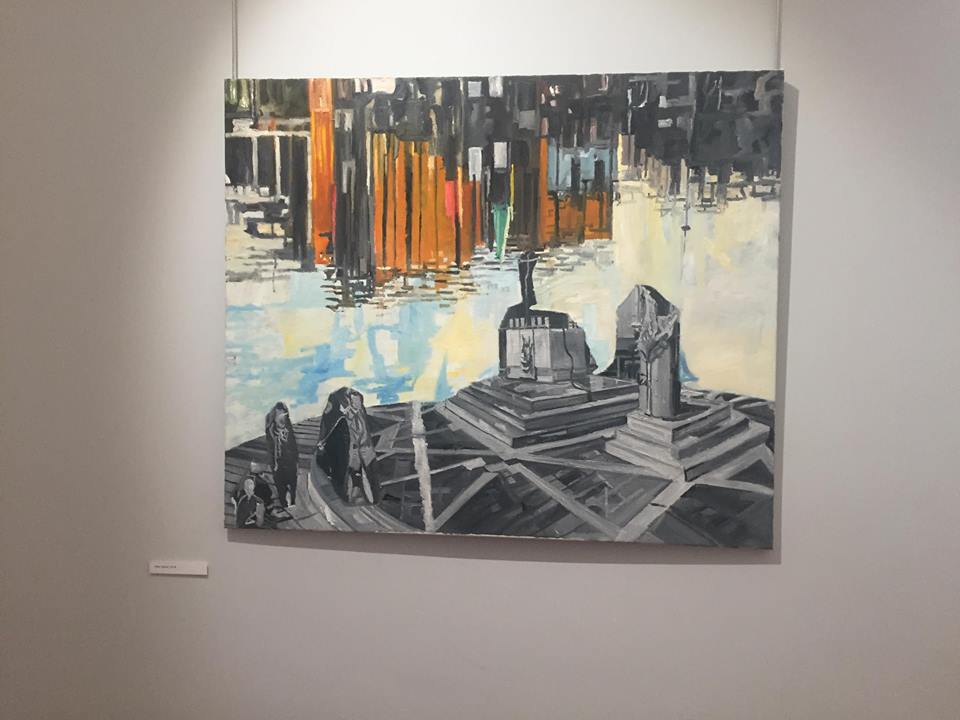
Jasmir Creed takes a step back and observes the world around her
Jasmir Creed explores in depth urban cities around the UK, describing herself as a ‘quiet observer’ or a ‘flaneuse’ Jasmir Creed perfectly encapsulates the movement of urban life in her works. In life many people spend too much time consumed by the hustle and bustle, the idea that if we don’t move quick enough life will pass us by. But Creed is able to take a step back and observe the everyday, using her observations of intriguing, urban architecture and of the blur of the people around her in her pieces. Psychogeography plays a key part in Creed’s thought-process, examining, through her artistic practice, the effect of geographical locations on the emotions and behaviour of individuals. Her works give an interesting perspective as she has an individual view of the world, one which is intriguing as she is able to pick apart parts of the world around her as an artist.
The thing I like most about her works is the kind of disorientation the different layers and angles the works give the viewer. She plays beautifully with perspective, motion and contrasting colours to create pieces that disillusion.
Her current running exhibition is ‘dystopolis’ in the Victoria gallery, Liverpool. This gives a brilliant historical setting to her modern, urban paintings. The pieces inspired by Liverpool’s architecture immediately caught my eye. As someone who has lived in Liverpool most of my life, I enjoyed seeing Creed’s interpretation of my cities’ architecture. Seeing these pieces allowed me to analyse a new side to Liverpool’s architecture. ‘Sometimes lost’ for example explores the Liverpool cathedral also known as ’paddy’s wigwam’ to most Liverpudlians, the eye is drawn to the upside-down cathedral which is contrasted with the flux of the crowd which appear normally. The crowd is almost consumed by the cathedral as you look towards the back of it, I like this blur she has created here to further this idea of fast movement, as well as alienation.
Another piece that caught my eye was ‘unheard voices’ the name itself brings about some interesting connotations that one can explore. I am obsessed with the background that surrounds the train platform in this painting, the way the station is engulfed by this kind of swirl of colour. All these figures move on unknowing of who is observing them.
Although I enjoy her exhibition in the Victoria Gallery, I prefer the works she discussed in her lecture such as ‘Smog’, 2015 and ‘Shadow’, 2016. ‘Shadow’ has this flowy, fluid effect created by her use of Ink and mark making. I like the juxtaposition between the various sectors of the piece.
I am definitely captivated by Creed’s subject matter and the concepts behind her works. Her work is unique and her canvases convey something mysterious and alluring, highlighted greatly by her interesting perspective on the world around her.

 Blog on Contemporary Art